<pre id="vvttv"><mark id="vvttv"><progress id="vvttv"></progress></mark></pre>
    <pre id="vvttv"></pre>

      <p id="vvttv"></p>

          <p id="vvttv"></p>

                <p id="vvttv"></p>

                <pre id="vvttv"><cite id="vvttv"><progress id="vvttv"></progress></cite></pre>

                  <output id="vvttv"><dfn id="vvttv"><th id="vvttv"></th></dfn></output>

                    <p id="vvttv"></p>

                    雙擺系統的動畫模擬?

                    相關文檔: 單擺和雙擺模擬
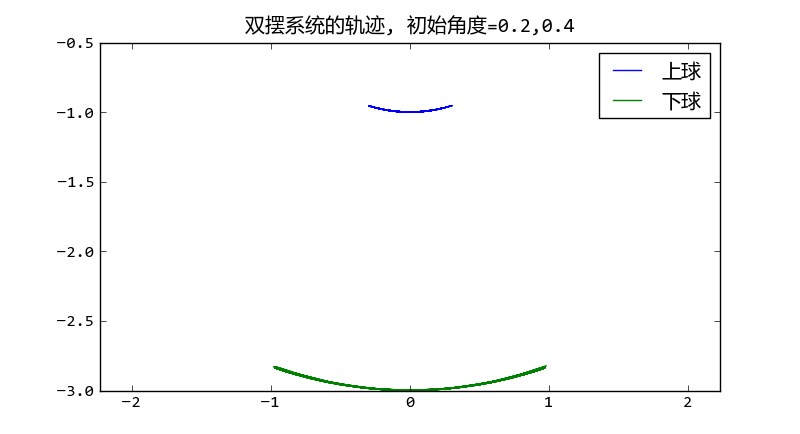
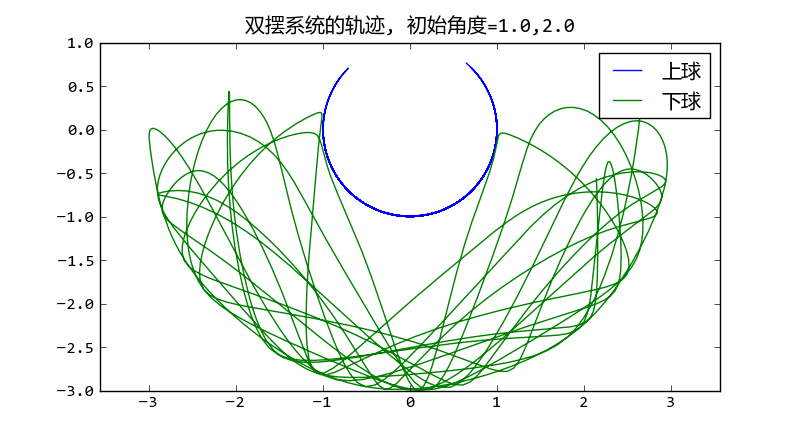
                    _images/double_pendulum02.png _images/double_pendulum03.png

                    用odeint解雙擺系統?

                    文件名: double_pendulum_odeint.py

                    # -*- coding: utf-8 -*-
                    
                    from math import sin,cos
                    import numpy as np
                    from scipy.integrate import odeint
                    
                    g = 9.8
                    
                    class DoublePendulum(object):
                        def __init__(self, m1, m2, l1, l2):
                            self.m1, self.m2, self.l1, self.l2 = m1, m2, l1, l2
                            self.init_status = np.array([0.0,0.0,0.0,0.0])
                            
                        def equations(self, w, t):
                            """
                            微分方程公式
                            """
                            m1, m2, l1, l2 = self.m1, self.m2, self.l1, self.l2
                            th1, th2, v1, v2 = w
                            dth1 = v1
                            dth2 = v2
                            
                            #eq of th1
                            a = l1*l1*(m1+m2)  # dv1 parameter
                            b = l1*m2*l2*cos(th1-th2) # dv2 paramter
                            c = l1*(m2*l2*sin(th1-th2)*dth2*dth2 + (m1+m2)*g*sin(th1))
                            
                            #eq of th2
                            d = m2*l2*l1*cos(th1-th2) # dv1 parameter
                            e = m2*l2*l2 # dv2 parameter
                            f = m2*l2*(-l1*sin(th1-th2)*dth1*dth1 + g*sin(th2))
                            
                            dv1, dv2 = np.linalg.solve([[a,b],[d,e]], [-c,-f])
                            
                            return np.array([dth1, dth2, dv1, dv2])
                            
                    def double_pendulum_odeint(pendulum, ts, te, tstep):
                        """
                        對雙擺系統的微分方程組進行數值求解,返回兩個小球的X-Y坐標
                        """
                        t = np.arange(ts, te, tstep)
                        track = odeint(pendulum.equations, pendulum.init_status, t)
                        th1_array, th2_array = track[:,0], track[:, 1]
                        l1, l2 = pendulum.l1, pendulum.l2
                        x1 = l1*np.sin(th1_array)
                        y1 = -l1*np.cos(th1_array)
                        x2 = x1 + l2*np.sin(th2_array)
                        y2 = y1 - l2*np.cos(th2_array)
                        pendulum.init_status = track[-1,:].copy() #將最后的狀態賦給pendulum
                        return [x1, y1, x2, y2]
                    
                    if __name__ == "__main__":    
                        import matplotlib.pyplot as pl
                        pendulum = DoublePendulum(1.0, 2.0, 1.0, 2.0) 
                        th1, th2 = 1.0, 2.0
                        pendulum.init_status[:2] = th1, th2
                        x1, y1, x2, y2 = double_pendulum_odeint(pendulum, 0, 30, 0.02)
                        pl.plot(x1,y1, label = u"上球")
                        pl.plot(x2,y2, label = u"下球")
                        pl.title(u"雙擺系統的軌跡, 初始角度=%s,%s" % (th1, th2))
                        pl.legend()
                        pl.axis("equal")
                        pl.show()
                    

                    擺動動畫?

                    文件名: double_pendulum_animation.py

                    # -*- coding: utf-8 -*-
                    import matplotlib
                    matplotlib.use('WXAgg') # do this before importing pylab
                    import matplotlib.pyplot as pl
                    from double_pendulum_odeint import double_pendulum_odeint, DoublePendulum
                    
                    fig = pl.figure(figsize=(4,4))
                    line1, = pl.plot([0,0], [0,0], "-o")
                    line2, = pl.plot([0,0], [0,0], "-o")
                    pl.axis("equal")
                    pl.xlim(-4,4)
                    pl.ylim(-4,2)
                    
                    pendulum = DoublePendulum(1.0, 2.0, 1.0, 2.0)
                    pendulum.init_status[:] = 1.0, 2.0, 0, 0
                    
                    x1, y1, x2, y2 = [],[],[],[]
                    idx = 0
                    
                    def update_line(event):
                        global x1, x2, y1, y2, idx
                        if idx == len(x1):
                            x1, y1, x2, y2 = double_pendulum_odeint(pendulum, 0, 1, 0.05)
                            idx = 0 
                        line1.set_xdata([0, x1[idx]])
                        line1.set_ydata([0, y1[idx]])
                        line2.set_xdata([x1[idx], x2[idx]])
                        line2.set_ydata([y1[idx], y2[idx]])
                        fig.canvas.draw()                 
                        idx += 1
                    
                    import wx
                    id = wx.NewId()
                    actor = fig.canvas.manager.frame
                    timer = wx.Timer(actor, id=id)
                    timer.Start(1)
                    wx.EVT_TIMER(actor, id, update_line)
                    pl.show()
                    

                    首頁目錄

                    上一篇文章

                    單擺擺動周期的計算

                    下一篇文章

                    繪制Mandelbrot集合

                      <pre id="vvttv"><mark id="vvttv"><progress id="vvttv"></progress></mark></pre>
                      <pre id="vvttv"></pre>

                        <p id="vvttv"></p>

                            <p id="vvttv"></p>

                                  <p id="vvttv"></p>

                                  <pre id="vvttv"><cite id="vvttv"><progress id="vvttv"></progress></cite></pre>

                                    <output id="vvttv"><dfn id="vvttv"><th id="vvttv"></th></dfn></output>

                                      <p id="vvttv"></p>

                                      这里只有精品视频